
2026 / 2027 Rates Update
Annual Plan Information
This year we continue our focus on ensuring Council remains financially sustainable while delivering essential services and investing in infrastructure and community facilities that support our growing municipality. Council has carefully balanced the need to maintain and improve services and assets with ongoing cost-of-living pressures affecting both households and Council's own operations.
Key initiatives and projects this year include:
- Railton Recreation Ground Redevelopment – development of concept designs and detailed plans for a modern multi-use community facility
- Implementation of a Waste Reduction and Minimisation Management Plan
- Improvements to Council's asset data and building condition assessments
- Development of a Youth Engagement Program
- Collaboration on a Mersey Leven Sub-Regional Tourism Strategy
- Progressing the Railton Structure Plan
- Improving online payment systems and digitising Council records
- Removal of high-risk roadside trees and updating fire evacuation diagrams in Council facilities
Our Annual Plan aligns with the 2026/27 Budget Estimates and reflects Council's commitment to maintaining service levels while responding to inflationary pressures, increasing service delivery costs and rising contractor and supplier expenses. Council continues to prioritise core services, responsible asset management and strategic investment in infrastructure that supports our community's future.
Waste management costs continue to increase due to significant rises in the State Government Waste Levy. From 1 July 2026, the levy increased by 53.8% to $70.56 per tonne. Council is commencing implementation of a comprehensive Waste Reduction and Minimisation Strategy to encourage waste diversion, recycling and behaviour change to help minimise future costs to the community.
The Breadth of Services delivered by Council
The breadth of services delivered by Kentish Council is extensive, reflecting our commitment to enhancing the quality of life for residents and supporting the overall development of the community including:
| Facilities Management | Sheffield Town Hall, Sheffield Visitor Centre, Kentish Health Care Centre, Barrington Hall, Beulah Hall, Claude Road Hall, Railton Kings Hall, Railton Recreation and Community Hall, Wilmot Memorial Hall, Railton Squash Courts, Sheffield Recreation Ground, Railton Recreation Ground, Wilmot Recreation Ground, Kentish Museum, Working Art Space, Sheffield Arts Centre, Railton Neighbourhood Centre, Public Art works. |
| Parks | King George V Park, Mural Park, Kentish Health Care Centre Park, Goliath Park, Lions Park, Railway Park, Sykes Sanctuary, O’Neills Creek Reserve, Wilmot Hall Park, Lake Barrington Park, 115ha of open space and the Wild Mersey Mountain Bike Trails. |
| Community Development | Delivery and support of community events, youth engagement initiatives, tourism development and community programs. |
| Stormwater Management | 20 km of stormwater piping, flood mitigation, drainage, detention systems. |
| Roads | 275 km of sealed roads and 190 km of unsealed roads, 62 bridges/culverts. |
| Waste Management | Sheffield Waste Transfer Station, Wilmot Waste Transfer Station and servicing of more than 1,800 bins. |
| Cemeteries | Seven cemeteries (three open for burials). |
| Animal Control | Dog registration and animal management services. |
| Building and Regulation Services | Building and plumbing inspections, environmental health, food safety and regulatory compliance services. |
| Planning Services | Development assessment and planning services. |
| Economic Development | Economic development and visitor information services. |
Rating Information
As required by the Local Government Act, Council's policy is based on the principle that rates are a form of taxation where ratepayers of similar wealth pay similar taxes, and those with greater wealth pay more. Property value is generally accepted as an indicator of wealth, and rates are considered a property-based tax rather than a fee for service.
To support Council's long-term financial sustainability and ongoing service delivery, the 2026/27 Budget includes:
- A General Rate increase of 6.8%, comprising the December 2025 CPI increase of 3.8% plus an additional 3.0% increase consistent with Council's Long-Term Financial Plan.
- A Waste Management Charge increase of 19.6% to support full cost recovery and respond to significant increases in waste disposal costs and the State Government Waste Levy.
While individual rate notices will vary depending on property valuations and circumstances, most residential ratepayers are expected to see an overall increase in rates and charges of approximately 12%.
The Valuer-General issues adjustment factors to be applied to property values for rating purposes. These adjustments are made by property class, resulting in some property class values increasing at faster rates than others.
For more information on assessed annual value - see the Frequently Asked Questions.
To lessen the impact of the change in property values on rates, Council has applied a general rate increase cap of 10% for all properties except commercial properties which continue to have a general rate increase cap of 50%.
The cap is only applied to the general rate component on your rates notice and does not apply to waste charges or fire levies.
Some properties will still be at the rate cap, while other properties have come off the cap and are transitioning towards paying the appropriate amount based on their property’s adjusted assessed annual value (AAAV).

Frequently Asked Questions
Rates are a tax levied by council. Their purpose is to support the council in providing services for the benefit of all residents.
Rates help pay for:
- Waste and recycling collection and disposal
- Animal Control
- Street lighting
- Local roads, footpaths and drainage
- Operation of halls and community centres
- Provision of amenities and cleaning
- Maintenance of parks, playgrounds and sports grounds
- Community Events
- State Government charges including fire services
Other works, programs and facilities
Generally, the owners of land have to pay rates. Occupiers of land may pay rates in exceptional circumstances. They may do so with the written consent of the owners. If someone other than the owner is paying the rates then the council needs to be notified accordingly.
If rates are not paid for a period exceeding three years, the Council may sell a property or part of a property to recover the unpaid rates. Council can sell it by public auction or by direct sale. If the owner of a property cannot be found, the council may apply to have that property transferred to the Council.
Any ratepayers who are experiencing genuine difficulties in paying rates can apply for alternative payment arrangements by contacting Council's Rates Officer on (03) 6491 0200 or by completing and submitting an Application to Extend Payment of Rates.
This is essential to avoid Council taking legal action to recover outstanding rates.
If you wish to check your rates balance, please contact council on (03) 6491 0200.
Any ratepayers who are experiencing genuine difficulties in paying rates can apply for alternative payment arrangements by contacting Council's Rates Officer on (03) 6491 0200 or by completing and submitting an Application to Extend Payment of Rates.
This is essential to avoid Council taking legal action to recover outstanding rates.
Council’s Financial Hardship Assistance policy also allows ratepayers that are experiencing genuine and serious financial hardship to apply for postponement or remission of rates. The criteria and evidence of financial hardship is detailed in the policy. Applications can be made in writing and submitted via mail or email. Council will notify applicants of all decisions in writing.
No. From the 2026/27 financial year, Latrobe Council no longer offers an early payment discount for rates paid in full.
The previous 1.5% discount was reviewed as part of Council's annual budget process. Removing the discount helps ensure all ratepayers are treated consistently and assists Council in keeping overall rates as low as possible for the community.
We understand some ratepayers valued the discount, and we continue to offer a range of payment options, including instalments, to help residents manage their rates.
The Assessed Annual Value or AAV represents an assessment of the rental value of a property or a 4 per cent minimum of the capital value (whichever is the greater value). The AAV is determined by the Valuer-General who is required to assess statutory values of all properties in Tasmania. Generally, an updated valuation of a municipality is undertaken every 6 years.
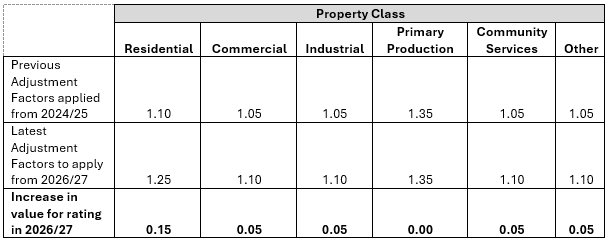
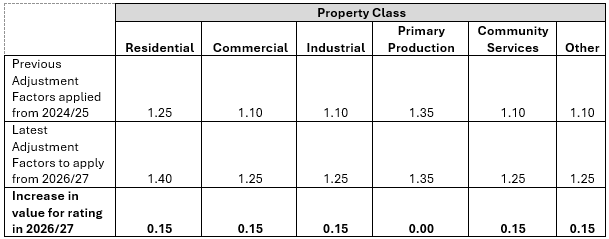
Every two years, the Valuer-General issues adjustment factors for each major category of property to make allowance for property market movements since the original municipal revaluation. Rates have been set this year based on the municipal wide revaluation in 2022/23 and subsequent adjustment factor provided by the Valuer-General. Under the Local Government Act, Council must rely on these valuations when setting rates.
The adjustment factors for assessed annual value (excluding vacant land) are as follows;
The adjustment factors for assessed annual value for vacant land are as follows;
In addition to the above municipality-wide valuations, the Valuer-General issues supplementary valuations for individual properties whenever a major change occurs to some aspect of the property (for example building improvements).
Council uses the Assessed Annual Value (AAV) attributed to each property by the Valuer-General and any subsequent adjustment factors issued then multiplies the adjusted assessed annual value (AAAV) by the cents-in-the-dollar rate, to arrive at the variable component of the general rates charge. A fixed component is also then added to the rates charge. In 2026/27 the fixed amount is $595 per property.
The capital value is the sum of money that might be realised if the land and any existing dwelling or improvements were offered for sale at a particular time. It includes both land value and the value of any buildings on the property. Council does not rely on this value in determining the rates for your property.
When properties are revalued by the Valuer General, their assessed values may change, leading to potential increases in rates for the owners. Revaluation increases can be significant, especially in areas experiencing rapid property value appreciation.
Rate capping is implemented by Council to prevent abrupt and large increases that may burden property owners and lead to affordability issues.
Striking the right balance between allocating the rate burden fairly for all property owners and limiting individual property increases is a challenge that Council considers when implementing rate capping measures.
The cap is only applied to the general rate component on your rates notice and does not apply to waste charges or fire levies.
Here’s how rate capping works to smooth revaluation increases:
- Limiting rate increases: Rate capping sets a maximum allowable percentage increase in property rates. For instance, if the rate cap is set at 10%, general rates will not increase beyond that limit, even if property values have risen significantly more during a revaluation period.
- Smoothing out revaluation impact: By capping the rate increase, the impact of revaluation is spread out over time. Rather than experiencing a sudden and substantial increase in rates after a revaluation, the rates are adjusted gradually within the set limit.
Maximum increase rate caps have been applied to the following land use categories for 2026/27.
All classes except commercial property – 10%
Commercial property – 50%
The rate increase cap does not apply to properties that received a supplementary valuation in the prior year due to an increase in the value of the property (usually because of property improvements).
The cap is only applied to the general rate component on your rates notice and does not apply to waste charges or fire levies.
If your property was subject to the maximum general rate cap, the addition of the uncapped increase in waste services charges may have further increased your total amount payable.
Waste management charges and the fire levies are not subject to the rate increase cap and have increased by more than 10% due to increasing waste management costs for Council.
This means that even with general rate cap in place, the overall total can exceed 10% when these additional charges are included.
Like businesses and households, Council has also experienced cost of living pressures through price increases from suppliers for the goods and services it uses to deliver the required services to the community.
The estimated total rate revenue increase for existing ratepayers is 6.8%. However, some properties will have increases higher than this due to previous increases in property values as determined by the Valuer-General.
To support Council's long-term financial sustainability and ongoing service delivery, the 2026/27 Budget includes:
- A General Rate increase of 6.8%, comprising the December 2025 CPI increase of 3.8% plus an additional 3.0% increase consistent with Council's Long-Term Financial Plan.
A Waste Management Charge increase of 19.6% to support full cost recovery and respond to significant increases in waste disposal costs and the State Government Waste Levy.
While individual rate notices will vary depending on property valuations and circumstances, most residential ratepayers are expected to see an overall increase in rates and charges of approximately 12%.
The waste transfer station charge is compulsory and applies to all properties to cover the operational costs of the waste transfer stations.
The waste transfer station charge for 2026/27 is $126.30 for properties that receive a waste removal service, $272.26 for ratepayers that do not receive a waste removal service and $516.29 for Commercial and Industrial Ratepayers.
Fees in 2026/27 for the transfer station if you receive a bin suite - $108.02
Fees in 2026/27 for the transfer station if you do not receive a bin suite - $272.26
This is an increase of $0.34 per week if you receive a bin suite, $0.85 per week if you do not receive a bin suite and $1.61 per week for Commercial and Industrial Ratepayers.
The increase in waste management charges in 2026/27 reflects full cost recovery of the kerbside collection service and the operation of waste transfer stations. The fees include an allowance for risks in unforeseen costs such as the illegal dumping of asbestos.
The State Government previously introduced the waste levy as a disincentive to sending waste to landfill. The money collected is being reinvested into improving local recycling, composting and resource recovery services, facilities, and infrastructure. The waste levy was $44.88 per tonne in 2025/26 and has increased by 53.8% to $70.56 per tonne in 2026/27.
Council's goal with the FOGO program is to divert more waste into recycling, reducing the amount of waste sent to landfill. This initiative will help minimise cost increases for council and ratepayers, and the associated requirement to increase rates.
Fees in 2026/27 for a 140L bin suite - $497.93
Fees in 2026/27 for a 240L bin suite - $615.82
The weekly increase per household is $1.55 for a 140L bin suite and $1.92 for a 240L bin suite.
The fire levy is collected by Council on behalf of the State Government to fund the Tasmania Fire Service (TFS), which is responsible for fire prevention, firefighting, and emergency response services across Tasmania. The levy is mandated by the Fire Service Act 1979, which outlines the responsibilities of property owners to contribute to fire services.